6
6“I'm such a fan of Garphill Games. There is a distinct design language running through their catalogue. Familiar iconography, clever interlocking systems - everything somehow makes sense. It's a formula I've thoroughly loved across the West Kingdom trilogy, while Raiders of the North Sea remains, in my opinion, one of the finest gateway worker placement games ever made. More recently, Ezra and Nehemiah proved just how adept Garphill are at creating deeply strategic experiences without descending into mechanical cacophony.
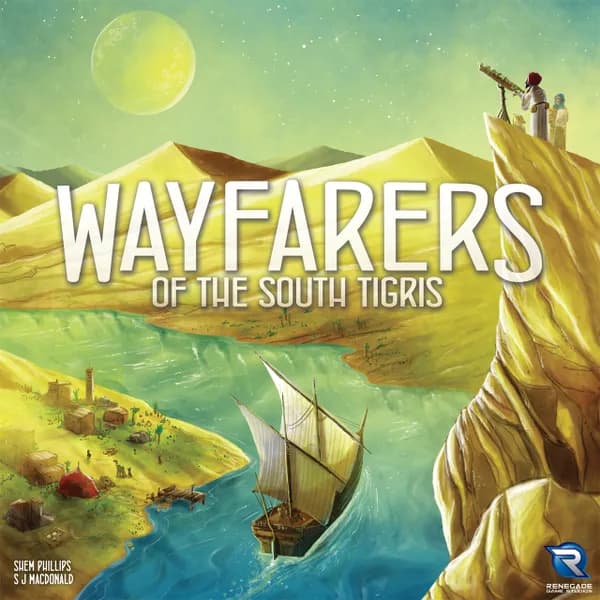
Wayfarers takes a different approach, leaning heavily into tableau building. Throughout the game, you'll expand both your land and sea tableau, steadily unlocking more actions. Alongside this, you'll recruit space cards that reward various end-game objectives, many of which revolve around the icons you've accumulated. Those set-collecting icons becomes the linchpin of the entire game. Diversifying them provides a good base for end-game scoring, yet specialising is equally important, as collecting three or four matching symbols is often what allows you to make progress along the Journal track. I personally love games where you're tackling the thought of whether breadth or depth is the wiser investment.
The Journal track itself acts as a subtle race, with players advancing explorers based on the icons they've gathered. Different icon combinations open different routes, and reaching the end is what ultimately triggers the game's conclusion.
A standout mechanism is the dice manipulation. Rather than simply assigning dice to actions, the game asks you to engineer which dice are even eligible to be used. If you want to take a sailing action, for example, you'll first need to slot one of your collected sail tokens into a specific value on your player board. Place it on the four, and suddenly a four can activate that action. Thankfully, various other icons you use on the board allow you to nudge dice values up or down, creating a wonderfully cerebral puzzle that feels original. It is one of those mechanisms that initially appears obtuse, only to reveal itself as remarkably intuitive after a round or two.
The theme retains that familiar Garphill identity. You'll still be gathering provisions, recruiting townsfolk, collecting coins and developing your little engine of efficiency. Yet, despite admiring virtually everything the game is trying to achieve, this is where my enthusiasm begins to wane.
Wayfarers is a game I enjoy, but it has never quite resonated with me in the same way as many of Garphill's other titles. I can't point to a glaring flaw. The mechanisms are intelligent, the decisions are meaningful, and the production is good. It simply lacks that ineffable spark that keeps drawing me back. And because of this, Wayfarers happens to be one that sits lower in my personal Garphill rankings.
That said, if this is your first experience with Garphill Games, don't let my preference discourage you. Their catalogue is consistently exceptional, and there's every chance Wayfarers will be the one that captivates you. ”

 6
6